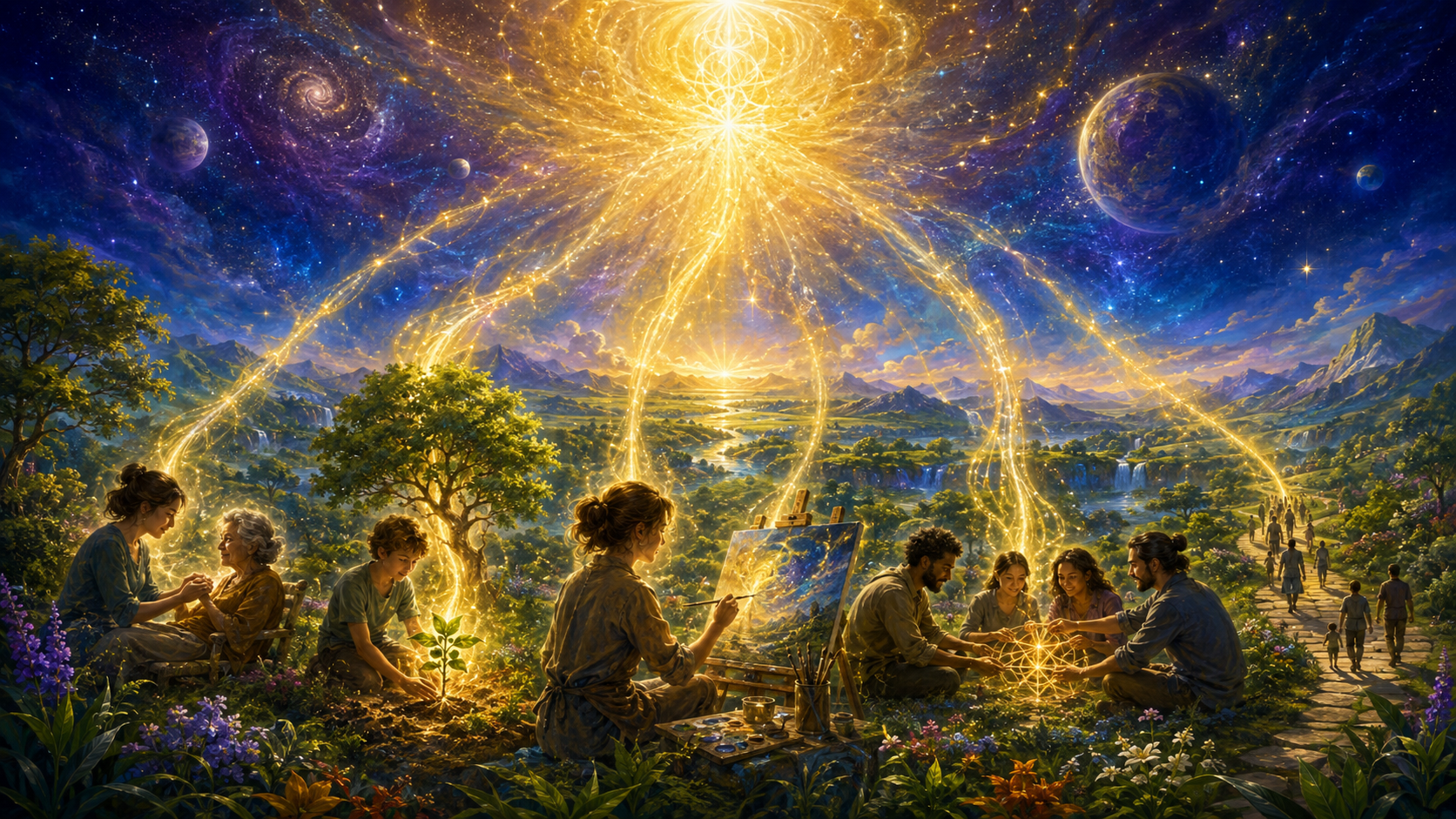
Few ideas transform our relationship with existence as profoundly as this one: the physical plane is not an inferior region from which we must escape, but an indispensable dimension of the One’s own movement of realization.
In many forms of spirituality, attention is directed toward another plane. The present world appears as exile, prison, trial, expiation, or mere preparation. True life would be elsewhere; our fundamental task would be to endure this passage and await a return to the spiritual.
Not every tradition says this in the same way. Many have recognized the dignity of the body, nature, work, and history. The Theory of Descent need not reduce centuries of religious thought to a single caricature. Its criticism addresses a persistent tendency: judging the physical world only by its limitations and forgetting the positive function those limitations can fulfill.
In the Theory of Descent, the physical plane is not the opposite of the divine project. It is an essential part of its actualization.
If the One contains everything, why create a world?
The central question returns: if the One is complete and contains every possibility, why is there manifestation? If nothing is lacking, creation cannot be explained as an attempt to remedy a deficiency.
The Theory of Descent distinguishes potential from experience. A possibility may be fully contained in the ground of reality without yet having been lived under determinate conditions. Love may exist as potential, but lived love requires someone who loves, someone who can be loved, freedom, distance, risk, care, and duration. Courage may exist as a possibility, but it becomes experience only when a consciousness encounters something to fear and nevertheless chooses to act. Justice may be conceived, but it needs concrete relationships, conflicts, institutions, and decisions in order to become history.
The physical plane provides precisely the conditions in which these possibilities can take form. It does not complete an imperfection in the One. Through finite perspectives and concrete relationships, it realizes what exists in the One as potential.
The body transforms intention into action
On the physical plane, wanting is not the same as doing. An intention must pass through the body, find means, overcome resistance, and become action. This passage gives ethical weight to our choices.
Compassion ceases to be an abstract feeling when hands provide care, when someone offers presence, food, shelter, or protection. Knowledge ceases to be an inner possibility when it becomes speech, teaching, technique, and creation. Love becomes visible in time given, work shared, and the decision to remain in the face of difficulty.
The body is not only a boundary that restricts consciousness. It is also consciousness’s capacity to be present in the world. Through the body, an invisible possibility becomes an event capable of reaching others.
The body is the place where intention accepts responsibility for its effects.
Space creates the possibility of encounter
Distance is often perceived as separation and loss. Yet without some distance there could be no approach. Without a here and a there, there would be no path; without a self and another, there would be no recognition.
Space allows singular positions to exist. Each consciousness occupies a perspective that no other can completely reproduce. This partiality is not merely ignorance: it is the condition through which the universe can be lived from many points of view.
When I cross the distance toward another, I do not simply return to what I already was. I learn to recognize a reality I do not control and a freedom that is not an extension of my own. Encounter acquires value because closeness was not guaranteed in advance.
Time permits learning and transformation
On the physical plane, things do not happen all at once. There are beginnings, development, consequences, and memory. This succession can be painful, but it makes possible processes that could not exist within absolute simultaneity.
Learning requires time. A promise requires a future in which one’s word can be confirmed. Forgiveness presupposes a past wound and a relationship seeking another form. Identity, too, is constructed in time: we are not only what we have received, but what we do with what we have received.
Time transforms potentials into trajectories. A possibility becomes a choice; the choice produces effects; the effects return to consciousness as learning. This is how experience can become wisdom.
Resistance gives realization its density
In the physical world, every realization encounters conditions that do not immediately obey the will. Matter has its own rhythms, limits, and causalities. Other people have needs and choices of their own. Society offers possibilities, but it also carries inequality and historical conflict.
This resistance must not be romanticized. Illness, disasters, violence, and oppression cause real suffering. The Theory of Descent does not authorize the claim that every pain was planned to teach a lesson, or that victims secretly chose what happened to them. Turning all suffering into a divine instrument would diminish the gravity of injustice and the responsibility of those who produce it.
The point is different: in a world of real conditions and relative freedoms, potentials find a field of actualization that is not merely imaginary. Resistance makes action meaningful, but it does not make every obstacle good. Many obstacles exist precisely to be transformed by courage, knowledge, solidarity, and justice.
The greatness of the physical plane lies not in sanctifying every pain, but in allowing care and transformation to become real in the face of it.
Neither punishment nor expiation
When the physical plane is interpreted primarily as punishment, existence begins under the sign of guilt. When it is seen only as expiation, pain risks being accepted as a metaphysical debt. When it is reduced to a test, the world can seem like a disposable stage built to evaluate souls.
The Theory of Descent proposes another image. This plane is a dimension created within the One’s movement of manifestation. Its limits are not necessarily penalties: they are structures that make location, choice, encounter, work, creation, and responsibility possible.
This changes the question. Instead of asking only, “How do we get out of here?”, we ask, “What can become real here?” Physical life ceases to be an interval between more important existences and becomes an irreplaceable form of participation in the divine process.
The spiritual is not absent from matter
Valuing the physical plane does not mean denying spiritual dimensions or reducing consciousness to matter. It means rejecting the simple opposition in which the spiritual is pure and valuable while the physical is degraded and secondary.
In the Theory of Descent, the physical can be understood as one of the forms through which the spiritual determines itself and becomes experience. Matter need not be worshiped or despised. It must be recognized as a condition of expression.
If consciousness continues beyond bodily life, that does not diminish the importance of this life. On the contrary, what is lived here participates in the formation of consciousness. The spiritual does not replace the physical; it receives, integrates, and expands experiences that could acquire their particular density only by passing through body, space, time, and otherness.
A spirituality committed to the world
This understanding has profound ethical consequences. If the physical plane is a field of actualization, caring for the body is not a spiritual distraction. Protecting nature is not attachment to an inferior reality. Fighting poverty and violence does not mean ignoring the destiny of the soul. Education, science, art, health, dignified work, and justice become ways in which potentials of the One can find conditions for realization.
Nor is it enough to glorify matter in the abstract while concrete people are deprived of the minimum conditions needed to develop their possibilities. Hunger restricts freedom. Oppression mutilates perspectives. Environmental destruction threatens the physical web on which all human experience depends.
To recognize the greatness of this plane is to assume responsibility for it. A spirituality of descent does not abandon the world in the name of heaven; it seeks to make the world capable of welcoming more consciousness, freedom, relationship, and care.
Return does not cancel embodiment
The movement of return does not correct an error made when the One manifested. It integrates what manifestation made possible. Consciousness does not return empty to its point of origin: it returns transformed by choices, encounters, creations, losses, and recognitions.
This is why the greatness of the physical plane is bound to the greatness of return itself. Only what has first become experience can be integrated. The One does not create matter only to erase it afterward as though nothing had happened. Descent finds its purpose when what has been lived can participate in a more conscious communion.
The physical plane is the great field of actualization: within it, divine potentials acquire body; through the body, they become relationship; through relationship, they become consciousness; and within consciousness, they can return to the One as realized experience.
To be here is not to have been abandoned
Perhaps one of the most beautiful consequences of the Theory of Descent is this transformation of meaning: to be in the world does not mean being far from the divine project. Finitude does not prove that we have been rejected. Matter does not demonstrate that we have fallen. Concrete life can be understood as active participation in a work of actualization.
We need not wait for another plane in order to recognize value, create meaning, or live the sacred. It is here that potential finds its conditions. It is here that freedom becomes decision. It is here that love becomes action. It is here that the One, through singular perspectives, transforms possibility into experience.