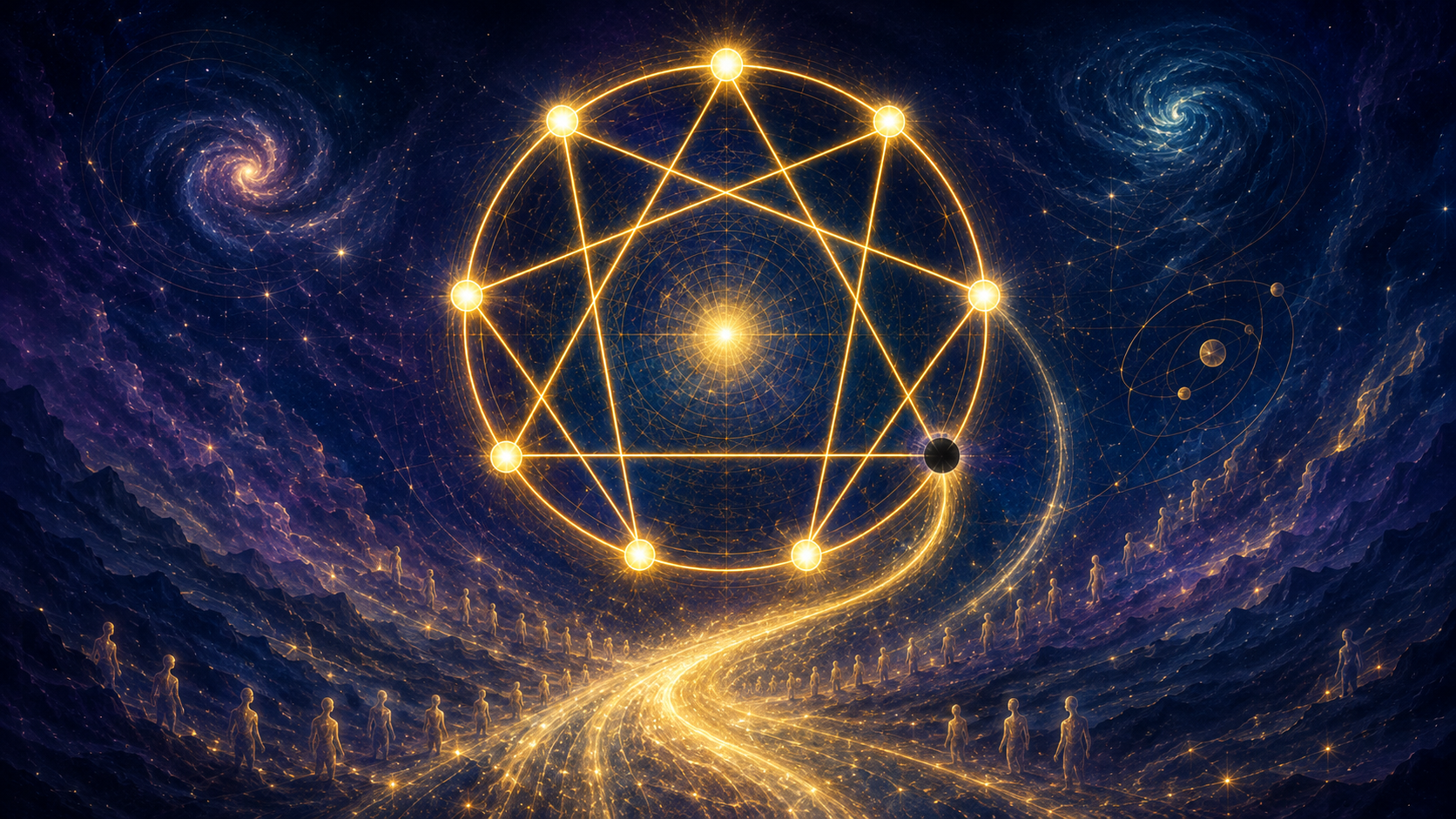
The Enneagram has become widely known as a system of nine personality types, used to explore motivations, automatic patterns, wounds, virtues, and paths of maturation. Yet before those psychological names are applied, what we see is a form: a circumference, nine points, a triangle, and an inner tracing.
The priority of the figure opens a broader question. Is the Enneagram merely a way of classifying people, or can it also serve as a symbol of universal processes—differentiation, movement, tension, integration, and return?
In this first article of the series The Enneagram and Unity, we propose a metaphysical reading of the symbol through the Theory of Descent. This is not a claim that ours is the Enneagram’s only authentic interpretation, nor an attempt to attribute it retrospectively to all its transmitters. It is an original hypothesis: the figure can make visible the way Unity differentiates itself without ceasing to be Unity and transforms potential into experience.
The Enneagram need not show only how a personality is organized. It can suggest how Unity becomes perspective, journey, and experience.
Before the types, the figure
When we begin directly with the nine types, we risk reducing the Enneagram to a catalogue of identities. The question “What is my number?” replaces deeper questions: How does a quality become fixed as a strategy? Why does consciousness identify with only part of its possibilities? What allows it to recover freedom and move again?
The figure shifts our attention from classification to relationship. No point exists alone. All belong to the same circumference and are also defined by the lines connecting them. The identity of a point is not a closed substance but a position within a field.
This shift already brings the Enneagram close to the Theory of Descent. A person is neither a metaphysical island nor an immutable type. Each is a localized perspective of consciousness, situated within relationships, processes, and possibilities that exceed present identification.
The circle: Unity containing difference
The circle is the Enneagram’s first visual foundation. It has no absolute beginning or end and embraces every other element. In a metaphysical reading, it can represent Unity—not an empty uniformity, but the totality that sustains differences without being divided by them.
Here, “Unity” does not mean that people, objects, and events are indistinguishable on the level of lived experience. Separation is real as relative experience: each person has a particular body, memory, responsibility, and point of view. Yet this difference need not be interpreted as absolute ontological independence.
The nine points remain within the circle. Likewise, space, time, individuality, and ego appear within the reality sustained by the Source. Manifestation does not take place outside the One, because an absolute “outside” of totality would be a contradiction. Descent is an internal differentiation of Unity.
A point does not cease to belong to the circle when it acquires its own position. Singularity does not break Unity; it gives Unity a place of experience.
A Unity full of potentials
In this interpretation, the circle does not represent an immobile and sterile perfection. The Source is understood as a plenitude of potentials: love, intelligence, will, creativity, beauty, freedom, and wisdom. Yet containing a possibility is not the same as living it under concrete conditions.
Love as potential has not yet encountered another to care for. Courage as potential has not crossed fear. Freedom as potential has not chosen among real alternatives. For these qualities to become experiences, they require difference, resistance, duration, and consequence.
Multiplicity therefore does not arise merely as the loss of a prior Unity. It creates the conditions of actualization. The circle contains; the points distinguish; the lines relate; movement transforms.
The triangle: the first differentiation
Within the circumference, the triangle connects points 9, 3, and 6. The tradition of the symbol associates this triangle with the action of three forces. In the reading developed by this blog, it can express three inseparable aspects of the Source’s potential: will, wisdom, and action.
Will is the impulse toward expression, not a desire born from lack. Wisdom is the ordering principle that provides proportion, structure, and intelligibility. Action is actualization: that which brings a possibility into the realm of events.
They are not three substances or three gods. They are discernible dimensions of one movement. Will without wisdom would be direction without order; wisdom without action would remain possibility; action without orientation would lose meaning. In the Source they form a Unity. In manifestation they can appear as distinct functions and moments.
The triangle therefore reveals something decisive: difference can arise within Unity without destroying it. The many need not be the enemy of the One; they may be the unfolding of its fecundity.
The nine points: perspectives, not prisons
The nine points can be read as modes of specialization. Each emphasizes a quality, a sensitivity, and a way of responding to reality. Specialization is necessary: a perspective contemplating everything simultaneously would not possess enough focus to live a singular experience.
The difficulty begins when specialization becomes exclusive identification. Consciousness stops saying, “I experience the world mainly from this point,” and begins to believe, “I am only this point.” A function becomes a prison; a partial perspective presents itself as the whole.
At this threshold the defensive ego emerges. It need not be treated as an evil entity to be exterminated. It is a protective organization of individuality that has forgotten the greater field in which it participates. Its limitation is not that it provides experience with a center, but that it treats this center as separate and self-sufficient reality.
Individuality says, “I am this perspective of the Source.” The separate ego says, “I am only this perspective, and I must complete myself against the world.”
The inner tracing: consciousness in motion
The inner lines prevent the Enneagram from becoming a collection of nine compartments. They suggest circulation, passage, and transformation. A point can only be understood in relation to other points; stability contains movement; identity holds paths of disidentification and integration.
Through the Theory of Descent, this tracing can symbolize the journey of the divine fractal: a localized expression of the Source entering the conditions of experience. The word “fractal” is used here analogically. It indicates a part that preserves a structural relationship with the whole, not a mathematical or scientific demonstration about consciousness.
In this hypothesis, the soul never leaves the circumference and never abandons the Source ontologically. It moves through positions within Unity. It experiences itself as limited, constructs defenses, suffers the consequences of forgetting, and can once again expand its awareness of participation.
Three necessary illusions: space, time, and individuality
For Unity to be lived through multiple perspectives, three conditions become especially important. We call them “necessary illusions” not because they are nonexistent, but because the absolute separation they seem to present is not the ultimate truth.
Space creates distance. It makes possible here and there, approach and withdrawal, presence and absence. Without distance there would be no encounter: no being could move toward another, care for another, or cross the interval distinguishing them.
Time creates sequence. It makes possible learning, waiting, memory, promise, and maturation. What would be contained simultaneously in the Source is lived as process. A quality must be chosen and reiterated before it becomes character.
Individuality creates point of view. It makes possible responsibility, authorship, and the relationship between an I and a you. Its risk is forgetfulness: the localized perspective can believe it exists in isolation. Its greatness lies in allowing the Whole to live an experience that only that angle could offer.
These three veils should not be rigidly assigned to points or lines as though the figure provided an unequivocal historical code. Their correspondence is an interpretive construction of the Theory of Descent. Its value lies in illuminating the symbol and organizing reflection on experience.
Point 1: from potential perfection to lived perfection
The narrative inspiring this article suggests reading point 1 as an image of potential perfection and also as a symbolic place of return. At the beginning of the journey, perfection means what the Source contains in essence. After the crossing, perfection gains another meaning: the conscious integration of what has been lived.
The first is perfection as possibility; the second, as actualization. The first has not encountered resistance; the second has transformed resistance into learning. The first contains love; the second has loved. The first contains freedom; the second has chosen. The first contains wisdom; the second has discerned within time.
This requires another caution: we are not identifying psychological Type One with divine totality, nor claiming that a fixed metaphysical sequence historically begins at this point. Point 1 serves here as a hermeneutical resource for distinguishing potential origin from experiential fulfillment.
The ego as a contracted longing for Unity
When the point forgets the circle, it seeks outside itself the completeness it still carries as an obscure memory. It seeks perfection, love, value, security, freedom, recognition, peace, intensity, or meaning. Each search touches something legitimate, but does so in a contracted manner: it tries to possess in isolation what can only be fulfilled in relationship.
This approach changes psychological work. The ego is not merely a collection of defects. It is also a diverted potential, a quality that has lost breadth by becoming a compulsive strategy. Healing does not mean humiliating personality, but freeing its central quality from the obligation to defend a separate identity.
Self-knowledge therefore ceases to be the discovery of a label and becomes the observation of a process: When does my perspective close in on itself? What quality am I trying to guarantee through control? What happens when I recognize the other positions within the circle?
Integration is not the dissolution of personality
Returning to Unity does not mean erasing the point. If individuality were merely eliminated, descent itself would lose its purpose. Return must integrate singularity rather than annul it.
An integrated person still possesses history, abilities, limitations, and style. The difference is that they no longer confuse their present form with everything they can be. Their center becomes open to other potentials, their identity more flexible, and their relationship with others less defensive.
This is why the most fitting image is not a circle ending exactly where it began, as if nothing had happened. It is a spiral. Unity encounters itself again, enriched by the perspectives that have lived, chosen, erred, learned, and offered the Whole singular experiences.
Return does not erase the point; it teaches the point to live consciously as an expression of the circle.
From symbol to practice
A metaphysical reading has value only if it changes the way we live. The circle invites us to remember common belonging. The points teach respect for singularity. The lines remind us that no identity is static. The triangle asks that intention, understanding, and action remain related.
In practice, this means observing our fixation without turning it into destiny; recognizing in another a possibility our specialization does not exhaust; accepting the time transformation requires; and turning abstract qualities into concrete gestures.
A person does not overcome ego merely by thinking about Unity. They actualize Unity when they listen to what their defenses did not want to hear, assume responsibility without losing dignity, bear difference without turning it into threat, and offer their singularity to the building of a relationship.
A program for this series
This first article establishes the horizon of The Enneagram and Unity. Future texts may examine the nine points as specializations of consciousness; the difference between individuality and ego; defensive strategies as contracted potentials; movements of disintegration and integration; and the possibility of thinking of each point as possessing more than one dimension.
Dialogue with psychology will remain indispensable, but it will not be isolated from metaphysics and ethics. The question will not be merely “What is my type?” but: What potential seeks fulfillment through this perspective? How does my fixation impoverish that potential? How does the encounter with other points restore mobility to consciousness?
The question hidden in the figure
The Enneagram begins with a circle and never leaves it. Within totality arise difference, tension, direction, and journey. Each point receives its own position but remains connected to a greater reality. This visual structure offers a powerful image for the Theory of Descent.
The Source contains potentials. Manifestation differentiates them. Space, time, and individuality make it possible to live them. Ego transforms necessary focus into absolute separation. Awakening does not destroy focus; it restores its memory of origin and relationship with all the other points.
Perhaps the Enneagram does not ask only, “Who are you?” Perhaps it asks: What possibility of the Source longs to become experience through you—and what must be integrated for that to happen?