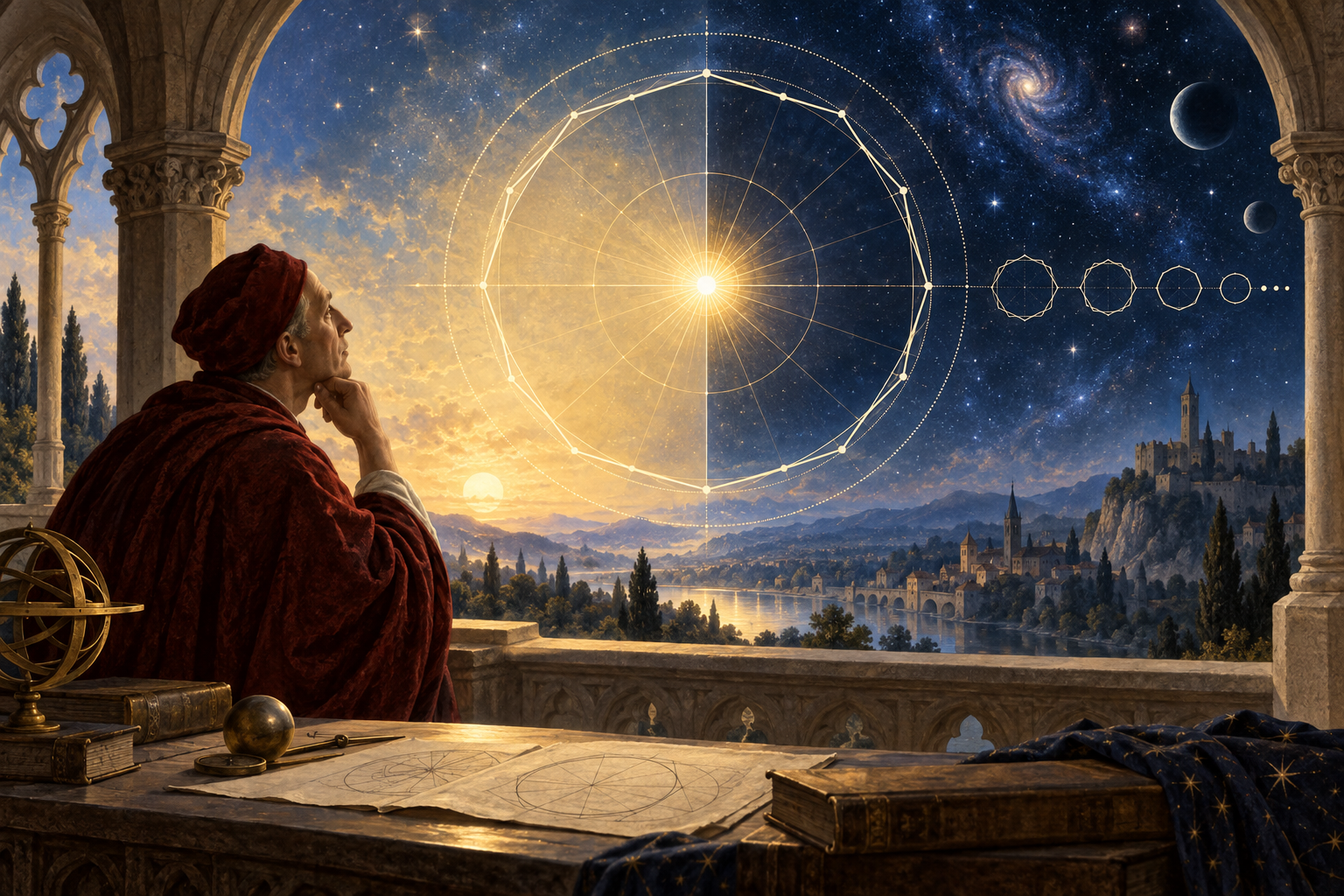
Our experience is structured by oppositions: unity and multiplicity, rest and motion, identity and difference, finite and infinite. To ordinary reason, each term excludes the other. Nicholas of Cusa, however, saw that this logic cannot simply be projected onto the Absolute. In the infinite, he argued, opposites coincide.
This is not an invitation to indiscriminately mix everything we distinguish. What appears divided on the finite plane may have its ground in a Unity that precedes divisions without making them useless. Here Cusa meets the Theory of Descent: the coincidence of opposites helps us think the unitary ground of reality, while descent asks why Unity differentiates itself, assumes limits, and crosses polarities so that potential may become experience.
Opposites do not cease to be different in the world of experience. They cease to be absolute when we recognize the ground that sustains them.
A thinker at the threshold between worlds
Nicholas of Cusa was born in 1401 in Kues and died in 1464. Philosopher, theologian, jurist, cardinal, and diplomat, he lived at a turning point: medieval categories remained powerful while Europe was opening to new images of the cosmos and new ways of knowing.
He did not abandon Christianity; he pressed its language toward the point where ordinary concepts no longer suffice. God cannot be treated as merely the greatest being on a common scale. If God is truly infinite, God is beyond proportion, comparison, and measure.
Learned ignorance: knowing that we do not know
Ignorance becomes “learned” when it recognizes the disproportion between a finite mind and infinite truth. This is not the abandonment of thought, but freedom from the illusion that our concepts can contain the Absolute. Knowledge becomes an approach rather than a capture.
This humility also places a demand on the Theory of Descent: no formulation of the theory should be confused with the whole reality it interprets. A map can guide a journey without becoming the territory.
The Absolute Maximum
Cusa calls God the Absolute Maximum—not the largest being among many, but that which lies beyond the opposition between greater and lesser. In infinity, maximum and minimum coincide. His mathematical paradoxes move the imagination to the boundary where finite categories begin to fail.
God is absolute Unity: not a numerical unit beside others, but the principle prior to division. Multiplicity does not compete with this Unity, because it can exist only by being sustained within it.
The coincidence of opposites
The Latin expression coincidentia oppositorum became the hallmark of Cusa’s thought. In the finite world, maximum and minimum, center and circumference, motion and rest differ and may exclude one another. In the Absolute, these oppositions do not have the same force, because infinity is not limited by a contrary term.
This does not mean every contradiction is secretly true, nor that justice and injustice, truth and falsehood, healing and violence are morally equivalent. Opposites may share a ground without possessing the same value. Ontological unity is not ethical equivalence.
To reconcile opposites is not to call evil good. It is to prevent evil from persuading us that separation, violence, and hatred are the ultimate truth of being.
The polygon and the circle
One of Cusa’s richest images is a polygon inscribed in a circle. As its number of sides increases, it approaches the circle ever more closely. Yet while it remains finite, it never becomes the circumference perfectly.
So it is with concept and reality. We can refine thought, compare perspectives, and correct errors, but no finite accumulation of concepts exhausts infinite truth. Wisdom lives in the tension between genuine approach and inevitable incompleteness.
The Unity that unfolds as multiplicity
For Cusa, the universe is not a collection of isolated things that must later be connected. Each being manifests the ground in a “contracted” way, limited by its own form, position, and mode. No creature is the fullness of the Absolute, yet each expresses something that would not appear in exactly the same way through another.
The Theory of Descent develops this intuition: finite forms are not merely partial expressions of the Source; they are conditions through which its potentials become singular experiences.
A universe without an absolute physical center
Cusa questioned the image of a perfectly motionless cosmos with an absolute physical center. This was not yet modern scientific cosmology, but the shift was profound: no created point can appropriate the infinite center. Each consciousness may be a center of perspective, but no particular perspective can declare itself the whole.
The human being as microcosm
The human being gathers matter, life, sensibility, reason, freedom, and openness to infinity. We are finite and know that we are finite; we participate in reality and can ask about its ground. Our incompleteness is not only a deficiency—it is a space for relationship.
Christ as union of finite and infinite
As a Christian thinker, Cusa understands Christ as the maximal union of human and divine nature. The finite is not destroyed by encountering the infinite; it is fully assumed. The Theory of Descent extends this question to all creation: the infinite may become present in the finite, and the finite may actualize possibilities of the ground without exhausting it.
From metaphysical coincidence to the experience of descent
The meeting point between Cusa and the Theory of Descent can be expressed in three movements: a Unity precedes every opposition; it manifests through real differences; consciousness can recognize that those differences were never separate absolutes.
The Theory of Descent then asks: why must Unity pass through differentiation? Its answer is that potential is not experience. Love, courage, knowledge, freedom, and communion must meet conditions of realization if they are to become more than abstract possibilities.
Space permits distance and proximity. Time creates duration, memory, and transformation. Individuality offers non-interchangeable perspectives. Forgetfulness makes Unity something that can be recognized at the end of a journey. These are necessary illusions: real as structures of experience, illusory only when mistaken for absolute separation.
The function of opposites
Opposites set experience in motion. Without presence and absence there could be no search; without the tension between possibility and actuality, no creation; without self and other, no encounter, care, or recognition.
Yet this does not mean every suffering was planned in detail or every act of violence is necessary. The conditions of finitude make conflict, loss, and error possible; they do not sanctify the acts that produce them. Opposition is fruitful when it creates contrast, choice, and relationship. It becomes destructive when one side seeks to dominate or dehumanize the other.
Offender and injured person: Unity is not impunity
To say that offender and injured person participate in the same Source does not erase the concrete asymmetry between the one who caused harm and the one who suffered it. Protection, justice, reparation, and boundaries remain necessary.
A unitive vision is legitimate only when it deepens responsibility. The offender cannot use Unity to minimize suffering. The injured person must not be pressured to forgive, reconcile, or “transcend” pain before their own time. Recognizing a common ground does not mean restoring an unsafe relationship.
Radical compassion is not the absence of discernment. It may desire the transformation of the person who caused harm while firmly protecting the person who was harmed.
Return does not eliminate differences
If descent produces singular perspectives, return to Unity cannot simply erase all that has been lived. Return is integration. Each perspective brings relationships, discoveries, choices, and memories. Final Unity is not identical to initial undifferentiation: it is conscious communion, enriched by the journey of the many.
Mature Unity is not the solitude of the One before the many, but the communion in which the many know that they were never outside the One.
A spirituality capable of sustaining paradox
Cusa teaches us to resist answers that impoverish Mystery. Transcendence and immanence, reason and contemplation, limit and openness need not become mutually exclusive alternatives. Adult spirituality sustains tensions without confusing them or resolving them prematurely.
Learned ignorance protects this posture from arrogance. No private experience authorizes anyone to speak definitively for the Whole. No tradition possesses the entire circle; each draws a polygon around a truth that exceeds its borders.
Where Cusa ends and the Theory of Descent begins
It would be historically inaccurate to claim that Nicholas of Cusa anticipated the Theory of Descent. His concepts belong to fifteenth-century philosophy and theology. The dialogue is fruitful precisely because it preserves difference.
Cusa offers learned ignorance, the contraction of the infinite in the finite, and the coincidence of opposites. The Theory of Descent reorganizes related intuitions into a process:
- Unity contains potentials not yet lived as experience;
- descent creates differentiation, limits, and perspectives;
- polarities make relationship, choice, and transformation possible;
- consciousness traverses these differences concretely;
- awakening recognizes the common ground without denying history;
- return integrates experience into a communion that preserves singularity.
What in Cusa is coincidence in the infinite becomes, in the Theory of Descent, a journey of consciousness. Unity is the ground that descends into differences, lives their tensions, and returns able to recognize them as parts of a whole.
The secret is not to eliminate opposites
Unity without differences would be empty of relationship; differences without Unity would become fragments incapable of communion. Cusa shows that infinity exceeds the oppositions by which finite thought organizes the world. The Theory of Descent shows why those oppositions still matter: they build the stage of experience.
Awakening is not pretending that pain and love, injustice and care, or self and other are the same. It is seeing that none of these differences is the ultimate ground—and therefore choosing what leads experience back toward consciousness, dignity, and communion.
The One does not overcome opposites by destroying one side. It recognizes itself as the depth that permits difference, sustains relationship, and makes reconciliation possible.
Historical and interpretive note
This article brings Nicholas of Cusa into dialogue with the Theory of Descent without identifying the two systems. Terms such as “necessary illusions,” “actualization of potentials,” and “conscious communion” belong to the contemporary Theory of Descent. In Cusa, the coincidence of opposites primarily concerns the way finite distinctions are surpassed in divine infinity; it must not be used to relativize moral differences or deny concrete consequences.