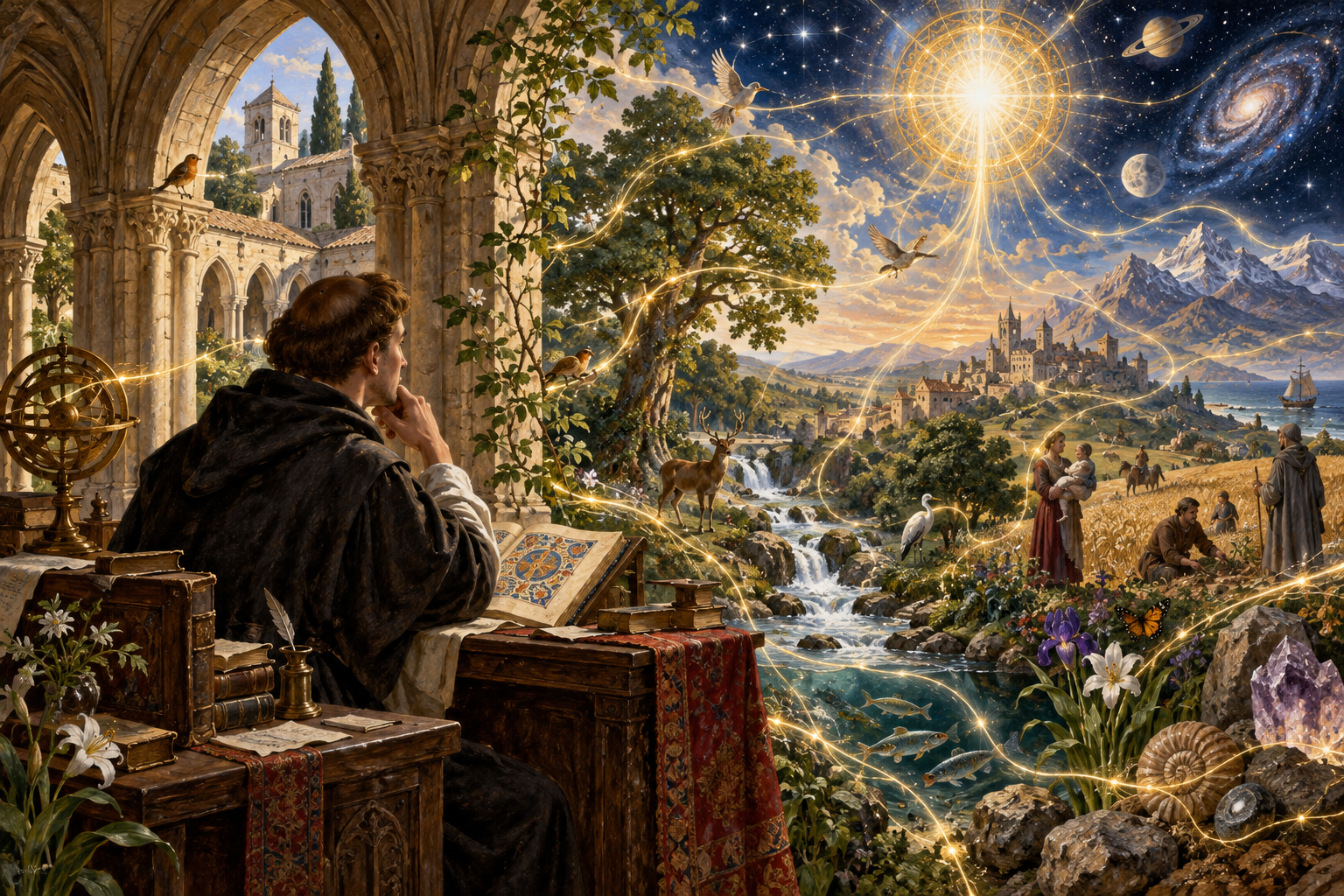
At the beginning of the thirteenth century, when Christian theology was seeking to define precisely the difference between Creator and creation, a Parisian master became associated with a disturbing claim: God is everything. His name was Amaury of Bène—also known as Amalric of Bena—and the tradition that formed around his ideas was considered dangerous enough to provoke condemnations, persecution, and executions.
The formula appears simple, yet it opens an abyss of questions. If God is in everything, is there still a real difference between the divine and the world? Does matter participate in the sacred, or does it merely depend on it? Does individuality possess a reality of its own? And how can we recognize Unity without dissolving freedom, responsibility, and the singular value of every being?
Amaury left us no secure and complete body of work. His thought reached us mainly through critics and documents of condemnation. This article therefore does not attempt to reconstruct a lost system with false certainty. Its purpose is to follow, cautiously, the intuition of radical immanence associated with his name and place it in dialogue with the Theory of Descent.
Perhaps the world does not stand before God as something external. Perhaps it exists within a presence that sustains it, permeates it, and manifests itself through its differences.
A master shrouded in silence and controversy
Amaury was probably born in Bène, in the region of Chartres, and taught in the intellectual world of Paris around the end of the twelfth century and the beginning of the thirteenth. He became known as a skilled dialectician at a time when new philosophical translations were enlarging the horizon of European schools while also intensifying tensions between rational inquiry and religious authority.
There is, however, a decisive difficulty: we possess no texts that allow us to present his philosophy directly and confidently. Almost everything we know was transmitted by authors who wanted to refute him or by accusations later directed against the Amalricians. A proposition attributed by an opponent may preserve an authentic intuition, but it may also simplify, displace, or deliberately scandalize it.
This historical caution does not make Amaury less interesting. It reveals something important about the history of ideas: some forms of thought survive not in intact treatises, but in the questions their opponents were unable to erase.
“God is everything”: What might this formula mean?
The most famous statement associated with Amaury was summarized as omnia sunt Deus: all things are God. Read literally, it seems to identify every particular object with the divine totality. A stone, a tree, and a person would simply be God without distinction. This interpretation has frequently been called pantheism.
Yet the formula permits a deeper reading. To say that God is everything may mean that nothing possesses a being wholly external to the divine ground. Every reality is distinct in form, properties, and history, but it exists only because it participates in a presence that is not external to it.
From this perspective, God would not be merely the first cause situated before the universe, like an artisan who finishes a work and remains separate from it. God would be the intimate actuality through which each thing is. The divine would exceed all forms while being present in all of them as their ground.
This distinction is essential. The claim that nothing exists outside God does not require us to conclude that any finite thing exhausts God. A wave is entirely water, but no single wave contains the ocean. The image is limited, yet it helps us imagine a Unity that communicates itself fully without being reduced to any one of its expressions.
Transcendence and immanence need not be enemies
The controversy surrounding Amaury is often presented as a choice between two alternatives: either God transcends the world, or God is in the world. But perhaps this opposition is insufficient. If transcendence means that the Source cannot be reduced to any particular form, and immanence means that no form can exist apart from the Source, the two may indicate complementary aspects.
Transcendence without immanence risks imagining God as distant from creation. The world becomes an abandoned stage, a secondary reality, or a waiting room for a life considered genuinely spiritual. Immanence without transcendence, on the other hand, can reduce the ground to the sum of phenomena and lose the distinction between the Whole and each finite manifestation.
The most fruitful unitary intuition preserves both movements: the Source is present in everything, yet is greater than everything in which it manifests. Every being participates in the divine, but no particular being can possess the divine as its exclusive property.
The Whole may be present in every form without each form, in isolation, being the Whole.
The world as manifestation, not exteriority
When creation is understood only as something produced externally, it becomes easy to separate spirituality from concrete life. God belongs above; matter, below. Salvation then consists in abandoning or enduring the world until we return to the plane considered truly valuable.
Radical immanence transforms this geography. Nature ceases to be spiritually empty matter. The body ceases to be merely a prison. History ceases to be an interval without dignity between origin and return. Everything becomes a possible place for the manifestation of Unity.
This does not mean that everything that happens is good or that every existing structure should be sacralized. The presence of the ground does not make cruelty just, illness desirable, or oppression divine. Confusing being with moral value would be a grave error. Unity sustains the possibility of existence; creatures remain responsible for the forms they give to that possibility.
Precisely because the world participates in the ground, caring for concrete life acquires spiritual depth. Protecting a body, restoring a relationship, defending dignity, and repairing an injustice are not distractions from the divine. They are ways of responding to the presence offered through finite forms.
Amaury and the Amalricians
After Amaury’s death, a group of clerics and scholars known as the Amalricians were accused of developing his ideas in still bolder directions. The sources attribute to them claims about a new age of the Spirit, divine presence in every action, and the possibility of experiencing heaven and hell as spiritual states already within this life.
In 1210, some members of the group were executed in Paris, while others received different punishments. The current associated with Amaury’s name was also condemned at the Fourth Lateran Council in 1215. These events show the political and religious force a metaphysics could assume: redefining the relationship among God, institution, person, and world also called established forms of mediation and authority into question.
It is not safe to attribute to the master everything taught by his followers, just as it is not safe to take every accusation as an impartial description. The historical Amaury, the Amalricians, and the image constructed by their adversaries are related but distinct layers.
A lineage of thinkers of Unity
Amaury occupies a singular place among the philosophers of Unity. Parmenides questioned the indivisibility of being. Plotinus explained multiplicity as procession from the One. Pseudo-Dionysius preserved the Mystery beyond every name. Eriugena understood the universe as theophany, a divine manifestation that proceeds and returns.
With Amaury, the question comes especially close to the fabric of the world: not only does everything proceed from God, but everything subsists within an inward divine presence. Unity is not merely an origin situated behind creation. It pulses within the being of things.
This proximity also makes his thought dangerous. If God is present in every being, no institution can present itself as the exclusive owner of that presence. If matter participates in the ground, the spiritual cannot claim superiority simply by despising the body. If every person is rooted in the same reality, human hierarchies cannot automatically be mistaken for hierarchies of being.
The encounter with the Theory of Descent
The Theory of Descent shares the affirmation that reality is one in its ground. There are not two absolutes—one divine and one material—locked in an eternal struggle. What we call matter, consciousness, and individuality belongs to the same process of manifestation.
But affirming Unity does not yet explain multiplicity. If God is in everything, why do things appear separate? Why does each consciousness perceive only part of reality? Why are there time, distance, unknowing, and otherness?
The distinctive contribution of the Theory of Descent begins precisely here. Multiplicity is not treated merely as an error of perception or a regrettable fall. It fulfills a function: it creates the conditions through which the potentials of the Source can become experiences.
Love in potential is not yet the encounter with someone who can accept or refuse it. Courage in potential is not yet a decision made in the presence of fear. Knowledge in potential is not yet discovery. For these possibilities to be actualized, there must be limited perspectives, real relationships, consequences, and duration.
The necessary illusions of manifestation
The Theory of Descent calls space, time, individuality, and forgetfulness necessary illusions. This expression does not mean that they are nonexistent or that we may ignore them. It means that they are real as conditions of experience, although illusory when interpreted as absolute separations within the ground of being.
- Space produces location and distance, allowing encounter, approach, care, and conflict.
- Time converts simultaneity into a journey, making learning, memory, and transformation possible.
- Individuality creates singular centers of perspective capable of offering experiences that no undifferentiated consciousness could live.
- Forgetfulness prevents Unity from being merely a conclusion given in advance and makes achieved recognition possible.
In this reading, separation is functional, not absolute. Each point must experience itself as distinct in order to live its own trajectory, yet its relative autonomy never breaks its ontological bond with the Source.
Separation creates experience; recognition reveals that experience never occurred outside Unity.
The difference between presence and actualization
Amaury helps us affirm that God is present in everything. The Theory of Descent adds that presence is not the same as actualization. A potential may be fully present as possibility and still require conditions in order to become a lived event.
A seed contains possibilities that appear only through its relationship with soil, water, light, and time. Likewise, a consciousness may participate in the Source without having realized all the qualities implied by that participation. Divine origin does not mean completed biographical perfection.
This gives dignity to process. Life is not a pointless repetition of what God already knows in the abstract. It is the field in which possibility acquires perspective, risk, consequence, and memory. The immanent divine does not annul history; it gives history its ground.
Unity without erasing the person
Every doctrine of Unity faces a risk: concluding that differences do not matter. If all are one, we might treat individual suffering as an irrelevant appearance or demand that victims quickly transcend their own pain.
The Theory of Descent rejects this shortcut. Singularity is precisely the instrument through which experience becomes possible. Each person gathers relationships, choices, and memories that cannot simply be replaced. The fact that all participate in the same Source does not diminish the value of the individual; it explains why no individual can be treated as disposable.
Unity is not uniformity. It is a communion capable of welcoming differences without turning them into isolation. Return does not destroy perspectives; it integrates what each one has made real.
An ethics of immanence
If the divine is at the heart of everything that exists, spirituality and ethics become inseparable. It is not enough to proclaim “God is everything” as a metaphysical formula. We must ask how we treat the concrete forms in which this presence manifests.
Recognizing the same Source in another does not eliminate disagreement, boundaries, or responsibility. It does, however, require us to reject dehumanization. The other is not merely an obstacle to my desire; the other is a perspective on reality that I do not possess. Listening expands the experience of the Whole. Violating another’s dignity impoverishes the communion in which I also participate.
The same consequence extends to nature. If matter is not external to the sacred, the world cannot be reduced to a storehouse of resources without value of its own. Ecological care ceases to be peripheral and becomes recognition of the ontological depth of manifestation.
Immanence is not a license to justify everything
The history of the Amalricians also warns against a dangerous interpretation: if God acts in everything, someone might conclude that no human action is truly evil or that an enlightened person stands above every norm. This passage from ontology to irresponsibility is illegitimate.
To say that every capacity to exist depends upon the ground does not mean that every way of using that capacity has equal value. Freedom manifests real potentials, including the possibility of obstructing, wounding, and denying relationships. Unity sustains agents; it does not automatically absolve their choices.
Within the Theory of Descent, the criterion is not the mere existence of an action, but what it actualizes. Does a choice enlarge consciousness, shared freedom, and communion—or does it produce domination, closure, and destruction? A metaphysics of Unity must deepen responsibility, not dissolve it.
What does Amaury offer the Theory of Descent?
Amaury offers an indispensable intuition: nothing can stand ontologically outside the Source. If something existed in absolute independence, there would be at least two ultimate grounds. Unity would cease to be Unity.
He also helps dismantle the image of an absent God whose greatness depends on distance from the world. A truly infinite Source does not need to compete with creation. It can be present in every being while continuing to exceed every form.
The Theory of Descent receives this immanence and adds a processual direction:
- the Source contains potentials not yet transformed into experience;
- differentiation produces perspectives and relationships;
- the necessary illusions make distinction appear real enough for a journey to exist;
- matter gives body and consequence to possibilities;
- consciousness converts events into lived experience;
- recognition reconstructs Unity as conscious communion among differences.
Amaury helps us say that God is in everything. The Theory of Descent seeks to explain why this Everything presents itself as many—and why the experience of the many has value for the realization of Unity itself.
Perhaps Unity was never absent
Amaury of Bène remains a historical figure who is difficult to reach. His voice was covered by accusations, by developments among his followers, and by the repression that sought to end his influence. Even so, the question carried by his name remains alive: does the world exist before God, or within divine presence?
The Theory of Descent responds that Unity never abandons its manifestations. It differentiates itself, assumes limits, experiences perspectives, and allows potential to become history. It does not descend because the world lies outside it, but in order to create, within itself, the real experience of otherness.
Return, then, is not an escape to a region where God may finally be found. It is recognition: perceiving that the Source was present in matter, consciousness, the other, and every moment of the journey. The great transformation does not consist in destroying multiplicity, but in enabling multiplicity consciously to remember what has always sustained it.
God is not only at the beginning and the end of the path. God is in the being of the one who walks, in the world traversed, and in the other who makes experience possible.
Historical and interpretive note
Because no writings securely attributed to Amaury of Bène have survived, the theses associated with him must be treated with caution. We need to distinguish the master, the Amalricians, and the descriptions produced by their opponents. The dialogue developed in this article does not claim that Amaury anticipated the Theory of Descent; it offers a contemporary philosophical approach based on the intuition of radical immanence connected with his name.