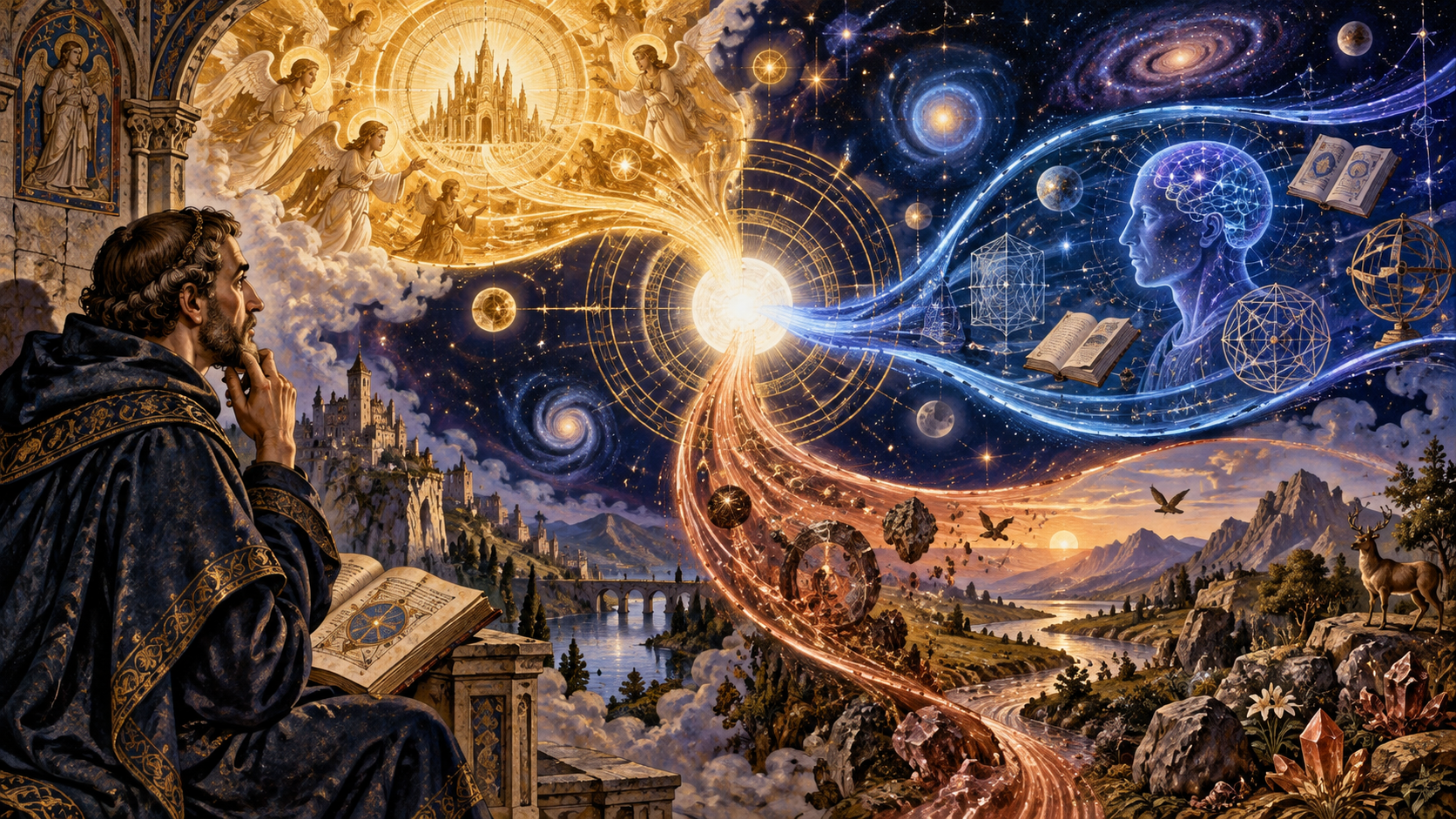
At the turn of the thirteenth century, David of Dinant formulated one of the most unsettling theses in medieval philosophy. According to the surviving fragments and the testimony of his critics, matter, intellect, and God were not three independent substances. At their ultimate root, they were a single principle.
The claim is so radical that it still destabilizes our categories. We are accustomed to separating the spiritual from the material, subject from object, and Creator from creation. David seems to cross these boundaries and ask whether they belong to ultimate reality or merely to the limited way reality presents itself to thought.
This intuition brings him close to the Theory of Descent, but it does not make him its complete precursor. David offers a powerful affirmation of Unity. The theory receives this provocation and adds another question: if everything is one, why does the One appear as many?
Radical Unity explains the common ground of everything. The Theory of Descent seeks to explain why this ground assumes differences capable of living, relating, and producing experience.
A philosopher nearly erased from history
We know very little about David of Dinant’s life. He was intellectually active around the year 1200 and is associated with the environment in which Aristotle’s works on nature were beginning to circulate forcefully in the Latin West. His thought reached us only in fragments, especially through authors who opposed him.
His writings, known as the Quaternuli—“little notebooks”—were condemned at the Synod of Paris in 1210, which ordered that copies be surrendered and burned. The prohibition was reaffirmed in 1215. For centuries, his position was reconstructed mainly from the criticisms of Albert the Great and Thomas Aquinas. Only in the twentieth century were manuscript fragments attributed to his work identified.
This requires caution. We do not possess a complete system written by David, nor can we accept without scrutiny every formula used by his adversaries. At the same time, the recovered fragments confirm that his philosophy did seek a profound unity among what we call matter, mind, and God.
Hyle, mens, and God
The best-known reconstruction of David’s thought begins with three terms: hyle, mens, and Deus.
- Hyle is prime matter, the indeterminate ground of bodies.
- Mens is mind or intellect, the common ground of souls and knowledge.
- God is the first principle, the ground that depends upon no other.
At first sight, we seem to be dealing with three domains: the physical world, intellectual life, and the divine. But David takes an additional step. If each of these principles is absolutely simple and devoid of internal differences, why should they be three? Thought would find no property in them by which to distinguish one from another. The conclusion attributed to David is extreme: the three names ultimately point to a single substance.
Bodies would be modes in which this reality appears under sensible forms; souls, modes in which it appears as intelligence; and God, the name given to the universal ground considered in its primordial indeterminacy. Distinction would exist at the level of manifestation, not as a rupture within the ground.
Matter is not the enemy of the divine
Perhaps the most provocative consequence of this position is the metaphysical rehabilitation of matter. In many religious interpretations, the physical world is described as an inferior level, a prison for the soul, or a region distant from God. Matter seems to mark the furthest possible removal from the sacred.
For David of Dinant, however, prime matter cannot be treated as a reality foreign to the divine principle. If God is the ground of everything and nothing can exist outside that ground, materiality cannot be a second realm standing over against God. It is a way in which the ground itself participates in the constitution of bodies.
The Theory of Descent finds a decisive affinity here. The physical plane is not a metaphysical mistake, a punishment, or a waiting room. It is the field in which potentials meet resistance, duration, consequence, and relationship. Without concrete conditions, the possible would remain merely possible. Matter gives experience its density.
Intellect and world: Is separation absolute?
The identification of mens and hyle also challenges the modern division between consciousness and world. If mind and matter belong to incommunicable grounds, it becomes difficult to understand how one could know or affect the other. David dissolves the problem at its root: that which knows and that which is known differ in manifestation, but they are not separated in origin.
This does not mean that a stone thinks like a human being, nor that every empirical difference disappears. It means that the capacity to know and the reality known emerge from the same ontological ground. Their encounter is not a bridge constructed after the fact between two isolated universes; it is a relationship made possible because there was never an absolute cleavage.
In the language of the Theory of Descent, individual consciousness is a localized perspective of Unity. The perceived world is another configuration of that same Unity. Experience arises in the meeting between perspective and otherness: the One knows its possibilities by living them under conditions of difference.
The power and limit of immediate Unity
David’s thesis possesses unusual force: it prevents us from turning the distinctions of the world into metaphysical abysses. God does not occupy a distant territory, matter has not been abandoned by the sacred, and intellect does not constitute an isolated kingdom. Everything remains rooted in Unity.
Yet this solution creates a new difficulty. If matter, intellect, and God are a single reality, where do forms, perspectives, movement, and history come from? Why is there an effective multiplicity of experiences? The identity of the ground, by itself, does not explain the richness of what appears.
This is where the Theory of Descent begins to follow its own path. It does not merely affirm that differences are, at bottom, a single reality. It seeks to understand the function of differences within the process of actualization.
Why must Unity appear as multiplicity?
For the Theory of Descent, the Source contains unlimited possibilities, but containing a possibility is not the same as experiencing it. Courage in potential is not yet the act of moving through fear. Love in potential is not yet the encounter between beings capable of welcoming or refusing one another. Knowledge in potential is not yet discovery, memory, or recognition.
Experience requires conditions that the absolute simultaneity of Unity does not directly provide. There must be a here and a there, a before and an after, a self and another, something known and something still unknown. Space, time, individuality, and forgetting therefore become functional structures of manifestation.
They are called necessary illusions not because they are nonexistent or worthless, but because they present as absolute separation what is in fact relative distinction. They are real as conditions of experience and illusory when taken as the ultimate ground of being.
Multiplicity does not correct a failure within Unity. It creates the conditions in which what exists as potential in the Source can become event, consciousness, and relationship.
God, matter, and intellect as moments of experience
In the light of the Theory of Descent, David’s triad can be reread dynamically. God indicates the Source and primordial potential; matter provides location, resistance, and consequence; intellect transforms events into perception, meaning, and recognition. These are not substances sealed within themselves, but articulated dimensions of a process.
This rereading does not claim that David formulated such a dynamic. It makes a dialogue explicit. Where the medieval philosopher identifies substantial unity, the Theory of Descent investigates the movement through which Unity differentiates itself functionally without ceasing to be one.
Matter allows potential to acquire form. Consciousness allows form to be lived. Relationship allows different perspectives to share, confront, and enlarge their experiences. Return does not erase these moments; it integrates what they made possible.
Unity is not uniformity
One danger in every philosophy of Unity is the reduction of differences to appearances without value. If only the One is true, persons, bodies, and histories may seem irrelevant. The Theory of Descent avoids this conclusion by distinguishing Unity from uniformity.
Uniformity means repetition without singularity. Unity means a common belonging capable of sustaining differences. Every being is a finite perspective, and precisely because it does not contain totality by itself, it needs encounters with other perspectives. Limitation is not merely loss: it is the condition that makes it possible to offer something singular to the whole.
Recognizing that everything proceeds from the same reality therefore does not erase ethics. It deepens it. To wound another is to strike an expression of the same Source; to listen is to allow one perspective of reality to reach another; to build communion is to make conscious the Unity that already sustains difference.
Between pantheism, panentheism, and the Theory of Descent
David of Dinant has often been classified as a materialistic pantheist: God and matter would be identical. Contemporary scholarship, however, shows that his position is more difficult to summarize. Some interpreters emphasize that his negative language seeks a ground without determinable properties, bringing his thesis close to forms of negative panentheism.
The Theory of Descent need not resolve this classification definitively in order to learn from David’s question. Nor can the theory be reduced to the simple claim that “the universe is God.” Its interest lies in the relationship between Source and manifestation: nothing exists outside Unity, yet no particular form exhausts Unity. The whole is present in its expressions without being limited to any one of them.
This difference is essential. Physical reality possesses divine dignity without each isolated object becoming the totality. Consciousness participates in the Source without possessing all possible consciousness. Unity is in everything, yet remains greater than every form it assumes.
What does David of Dinant offer the Theory of Descent?
First, David offers the courage to think Unity through to its ultimate consequences. If there is an absolute ground, there cannot stand before it a second, entirely independent principle. Matter and consciousness must be included within the intelligibility of reality.
He also offers an early critique of rigid dualisms. The spiritual need not be glorified by negating the body; intellect need not affirm itself through contempt for matter; and God need not be protected by a distance that makes the divine absent from its own manifestation.
The Theory of Descent receives these intuitions and adds a processual architecture:
- Unity contains potentials that are not yet experiences;
- differentiation creates perspectives and fields of relationship;
- space, time, matter, and individuality make actualization possible;
- consciousness converts events into lived experience;
- the meeting of singularities produces recognition and communion;
- return integrates multiplicity without erasing what was achieved within it.
David helps us understand why multiplicity never truly abandons Unity. The Theory of Descent seeks to show why, despite this, the passage through multiplicity matters.
Perhaps we never left Unity
The condemnation of the Quaternuli nearly erased David of Dinant from history. Yet the question contained in his fragments remained: do the boundaries between God, mind, and world belong to absolute being, or to the way finite consciousness organizes experience?
The Theory of Descent responds that distinctions are necessary, but not ultimate. We need to live them so that there can be a journey, choice, relationship, and discovery. We must also move consciously through them so as not to confuse perspective with isolation.
Perhaps return to Unity is not a journey to another place. Perhaps it is the recognition that the Source has never ceased to sustain matter, intellect, and every being—and that all experience is a way in which Unity transforms possibility into life.
We are not separated from Unity only to find it again later. Through differences, we are learning to recognize consciously what has never ceased to constitute us.
Historical and interpretive note
The historical presentation was checked against Henryk Anzulewicz’s research on the rediscovery of the Quaternuli fragments, the overview in the Routledge Encyclopedia of Philosophy, and the contemporary discussion of negative panentheism in David of Dinant. Because his writings survive only fragmentarily and many reports come from adversaries, historical attributions have been stated cautiously. The dialogue with the Theory of Descent is an original interpretation developed for this blog.