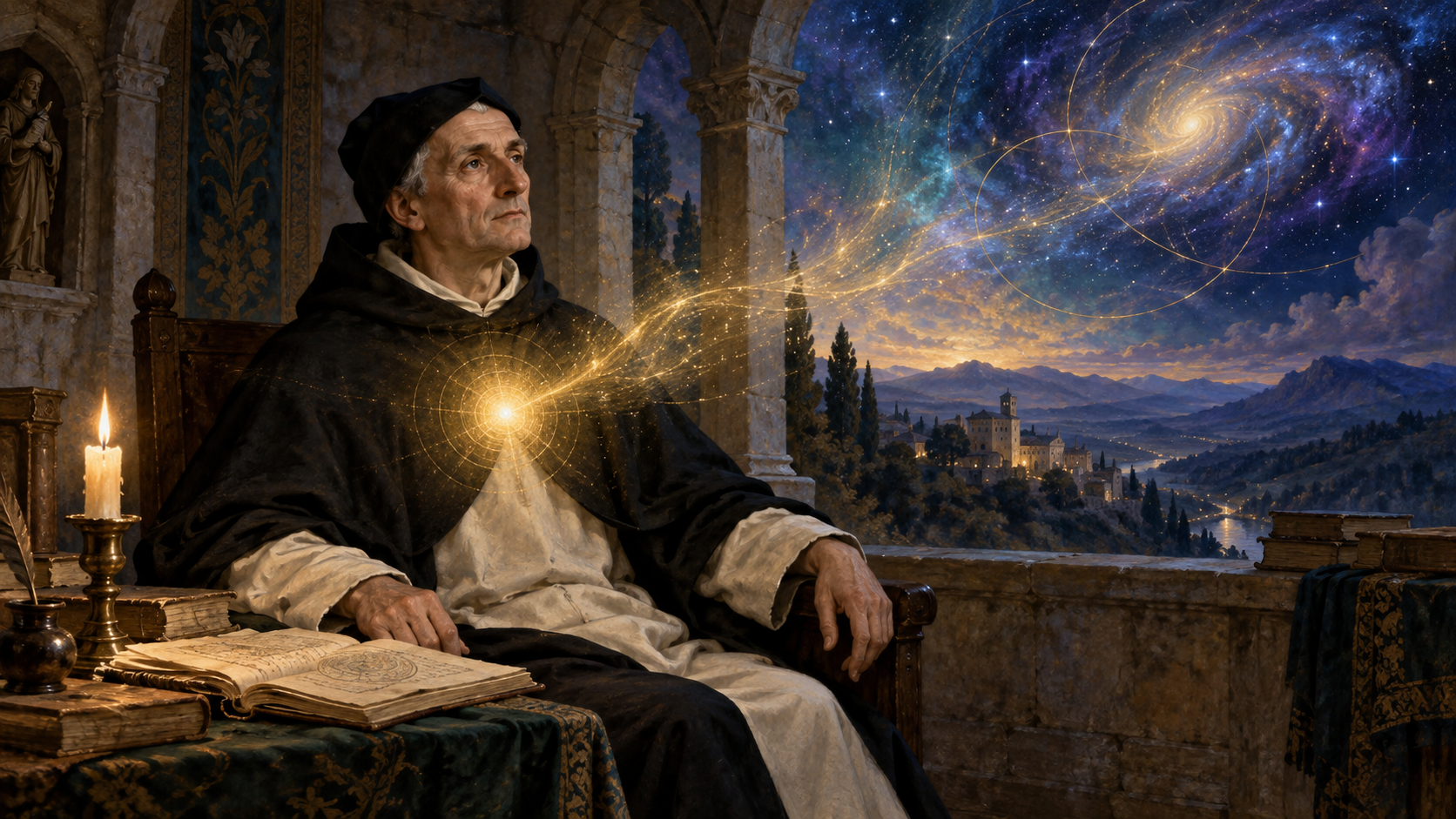
What if God were not only beyond the universe, as a distant reality, but also at the deepest point of our own being? What if there were within the soul a depth prior to the images we form of ourselves—a place where the separation between the human and the divine could no longer be understood in the usual way?
Few authors in the Christian tradition carried these questions as far as Meister Eckhart. In his sermons and treatises, the search for God is not presented merely as movement toward an external being. It requires a radical transformation of interiority: relinquishing the images to which consciousness clings, passing beyond the desire to possess even God, and discovering in the ground of the soul an openness in which the divine can be born.
This language brings Eckhart close to several decisive intuitions of the Theory of Descent. If every consciousness is a localized perspective of the Source, Unity does not disappear when individuality arises. It remains the living ground of experience. Yet bringing these two visions together requires care: Eckhart speaks from within medieval Christian theology; the Theory of Descent constructs a contemporary synthesis of potential, manifestation, otherness, and return. The dialogue becomes fruitful precisely when influence is not confused with identity.
Unity need not be sought only above or beyond the world. It may be recognized in the depth from which consciousness itself exists.
A master between the university and the pulpit
Eckhart was born around 1260 in Thuringia and entered the Order of Preachers, the Dominicans. His career combined philosophical study, religious responsibility, university teaching, and pastoral preaching. He taught in Paris—one of medieval Europe’s great intellectual centers—and held positions of leadership within his order.
This dual setting helps us understand his work. In his Latin writings, Eckhart takes part in scholastic debates on being, intellect, creation, and causality. In his German sermons, he addresses religious communities and lay audiences through daring images, paradoxes, and practical exhortations. There are not, however, two entirely separate Eckharts. Philosophical precision and mystical intensity belong to the same undertaking: to understand what happens when a creature recognizes its radical dependence upon God.
His teachings became controversial during the final years of his life. Some propositions drawn from his writings were later censured by ecclesiastical authority. This does not justify reducing him to a modern rebel against religion, nor does it erase the boldness of his language. Eckhart insisted upon his Christian fidelity while carrying certain possibilities within the tradition to a threshold where familiar formulas no longer seemed sufficient.
God and the Godhead: when the concept must be surpassed
One of the most provocative distinctions associated with Eckhart is that between God and the Godhead. It should not be understood as though there were two divine realities. “God” designates the divine as manifested, creating, relating, and capable of being named. “Godhead” points toward the formless, undetermined depth that no representation can contain.
When we think of God as good, wise, creative, or personal, we use concepts indispensable to religious language. Yet every concept arises within human experience and isolates one aspect of what it seeks to understand. If the absolute ground were identical with the image we form of it, it would cease to be absolute and become an object among others.
Eckhart thus radicalizes the legacy of Pseudo-Dionysius’s negative theology. It is not enough to replace an inadequate definition with a more refined one. We must recognize that even our highest ideas of God remain images. The spiritual passage requires reaching a point at which the mind no longer confuses its names with the reality it names.
To go beyond the image of God is not to deny the divine. It is to free the divine from the narrow measure of our concepts.
The ground of the soul
At the center of Eckhart’s thought is the language of the soul’s ground. He also employs images such as the spark, the inner castle, or something uncreated and uncreatable. These expressions are not meant to locate a tiny supernatural entity hidden inside the body. They indicate a depth that cannot be reduced to ordinary psychological activity.
Thoughts, memories, emotions, and desires are real, but they are in motion. They form the person’s history and give content to experience, yet they do not exhaust that by which the soul is capable of truth, freedom, and openness to the absolute. The ground is the silent dimension in which consciousness does not relate to God merely as a subject facing an object.
It is in this sense that Eckhart can speak of unity between God and the soul. He is not simply claiming that the individual personality is God, nor is he turning the everyday ego into an absolute. Psychological identity, with its preferences and defenses, does not take the place of the divine. Unity appears when the soul reaches a depth prior to egoic appropriation and recognizes that it does not possess the ground of its being in itself.
This distinction is decisive. To say “my ego is God” would reinforce precisely the enclosure that mystical experience seeks to traverse. The ground of the soul does not divinize individual vanity; it relativizes the self’s claim to be a self-sufficient reality.
The birth of God in the soul
For Eckhart, the birth of Christ should not be understood only as an external historical event. It must take place spiritually within the soul. God eternally begets the Word, and the soul becomes the place of this birth when it is free to receive it.
“Birth” is a dynamic image. Divine presence is not an object stored passively inside the human being. It must become actual, conscious, and fruitful. The soul does not merely possess a divine origin; it is called to allow that origin to manifest in the way it knows and acts.
Here we find an especially profound convergence with the Theory of Descent. The Source may be present as ground and potential without that presence having yet taken form in experience. Love, freedom, and wisdom are not fulfilled merely because they belong to the depth of being. They must be born in time as attention, choice, care, courage, and action.
The divine present as ground becomes experience when it is born in consciousness and takes form in life.
Gelassenheit: detachment even from possessing God
The path proposed by Eckhart is often associated with Gelassenheit: detachment, releasement, serenity, or letting-be. The term is not limited to renouncing material possessions. A person may abandon objects while remaining wholly attached to spiritual superiority, the need for control, or the image they wish to present.
Deeper detachment reaches the representations through which the self tries to possess reality. It includes expectations, rewards, certainties, and even an image of God used to guarantee security. As long as we seek the divine only to satisfy an egoic lack, we turn God into an instrument of our desires.
Detachment does not mean becoming indifferent to suffering, other people, or the world. It means ceasing to demand that everything confirm the identity we have constructed. The detached soul can receive reality without immediately reducing it to its projections. It creates inward space for the other to be other and for the ground to manifest in ways the self does not control.
Detachment therefore has an ethical consequence. The less a person needs to appropriate everything, the freer they become to act without turning their neighbor into an extension of themselves. Inner emptiness is not sterility; it is availability.
Three complementary paths of Unity
Pseudo-Dionysius, Eriugena, and Eckhart can be read as three complementary moments in a philosophy of Unity. In Pseudo-Dionysius, the emphasis falls upon transcendence: the principle lies beyond every affirmation and negation. Language ascends to its limit and then learns silence.
In Eriugena, Unity also appears as a cosmic movement. Reality proceeds from God, manifests God as theophany, and returns to its principle. The entire universe participates in a dynamic of procession and return.
Eckhart interiorizes this journey. The Mystery that exceeds concepts and the Source that manifests in the cosmos can be recognized in the soul’s depth. Unity is beyond everything, expresses itself through everything, and can become conscious experience within the human being.
These three directions need not compete. Transcendence without manifestation can make God distant; manifestation without transcendence can reduce God to the world; interiority without otherness can confuse spiritual depth with subjective enclosure. Together they offer a more balanced architecture: the ground exceeds all things, sustains all things, and can be recognized by a consciousness that remains situated among other consciousnesses.
From spark to fractal: a contemporary approach
The Theory of Descent proposes that every consciousness be understood as a localized expression of the Source. To formulate this relationship, it uses contemporary images such as fractality and holography by analogy. The fractal analogy suggests that a pattern of totality may reappear at different scales; the holographic analogy suggests that each region preserves an informational relationship with the whole.
It is important not to turn these images into scientific proofs. The physics of holograms and the mathematics of fractals do not, by themselves, demonstrate a metaphysics of consciousness. Their value here is hermeneutic: they help us imagine how Unity can be present in every part without each part, taken in isolation, being the whole of reality.
From this perspective, the ground of the soul described by Eckhart can be brought into dialogue with the structural presence of the Source in every consciousness. The individual does not carry a quantitative miniature of the universe within. Rather, the individual participates qualitatively in the same ground and bears potentials connecting it to totality.
The expression “divine fractal” seeks to preserve belonging and difference at once. Every consciousness proceeds from Unity and bears its mark, yet lives from an unrepeatable position. Totality does not annul the point; the point does not exhaust totality.
Where the Theory of Descent goes beyond Eckhart
The affinity between these visions does not remove a central difference. Eckhart concentrates on the inner liberation through which the soul becomes receptive to divine birth. The Theory of Descent also asks why Unity assumes the conditions of multiplicity and what positive function those conditions perform.
Space, time, body, and individuality are not only veils to be traversed in order to reach the ground. They create the field in which potentials can acquire experience. Without distance there would be no approach; without duration, no learning; without bodies, intention would not become gesture; without distinct perspectives, love would not encounter a free other.
Recognizing inward Unity does not therefore conclude the journey. Experience must return to the world of relationships. The silence of the ground must become responsible speech; detachment must become care; inner freedom must become action that enlarges the freedom of others. Otherwise mysticism risks remaining a private experience without historical actualization.
The Theory of Descent further adds that return does not consist simply in undoing differentiation. The movement takes the form of a spiral: consciousness recognizes its origin but carries with it what it has learned through finitude. Singularity ceases to imagine itself as separate without losing the unique contribution it has acquired.
To descend is to assume a point of view; to awaken is to recognize the Source within that point; to return is to offer communion what only that perspective could live.
The danger of turning the experience of Unity into privilege
Any language about a divine depth in the soul can be misread as a sign of spiritual superiority. Someone might imagine they have reached a special state and therefore no longer need to answer for their actions. Yet Eckhartian detachment points in the opposite direction: the more consciousness is emptied of appropriation, the less it can use the divine to magnify the ego.
The experience of Unity does not automatically erase psychological wounds, social conflict, or differences of interpretation. A mystical intuition must be integrated with critical intelligence, responsibility, and encounter with the other. The criterion of depth is not the grandeur of the account but the transformation of relationship.
If everyone participates in the same Source, no person can claim a monopoly over it. The ground of the soul is not the property of a religious elite; it is the radical possibility of openness inscribed in the very condition of consciousness. Recognizing it should produce humility, not a hierarchy of vanities.
A practice of interiority that returns to the world
Eckhart’s thought can inspire a practice without being reduced to a quick technique. The first movement is to observe the images with which we identify: Who do I believe I must be? What recognition do I demand? What idea of God do I use to protect myself from uncertainty?
The second is to cultivate enough silence to perceive that consciousness exceeds these forms. This does not mean destroying one’s personal history, but ceasing to treat it as the whole. Thoughts and emotions can be received without being given the power to define being absolutely.
The third movement is return to relationship. The depth discovered within must be tested in encounter. Am I becoming more capable of listening? Less dependent on control? More available to concrete care? Can I recognize in the other an expression of the same Source without erasing their difference?
In this passage, contemplation ceases to be escape and becomes preparation for presence. The soul withdraws not to abandon the world, but to return to it less imprisoned by its projections.
Unity in our deepest ground
Meister Eckhart offers the Theory of Descent an intuition of extraordinary power: Unity is not only at the remote origin of the universe or solely at creation’s final destination. It remains present in the ground of consciousness. The soul can recognize it when it ceases to confuse its deep identity with the ego’s transitory forms.
The Theory of Descent receives this intuition and places it within a broader movement. The Source lies beyond every concept, manifests itself in the cosmos, becomes localized in singular perspectives, and transforms its potentials into experiences through body, time, and otherness. The ground of the soul is not the end of the journey, but the place of a decisive remembrance: we have never been ontologically outside Unity.
This remembrance, however, must be born. It must pass through silence and become life. The divine is not fulfilled humanly when it is merely affirmed, but when consciousness allows love, freedom, and wisdom to take concrete form in its relationships.
Perhaps God is not only above us or before us. Perhaps God is the depth that sustains us—and waits to be born, as consciousness and relationship, through the singular way each of us inhabits the world.