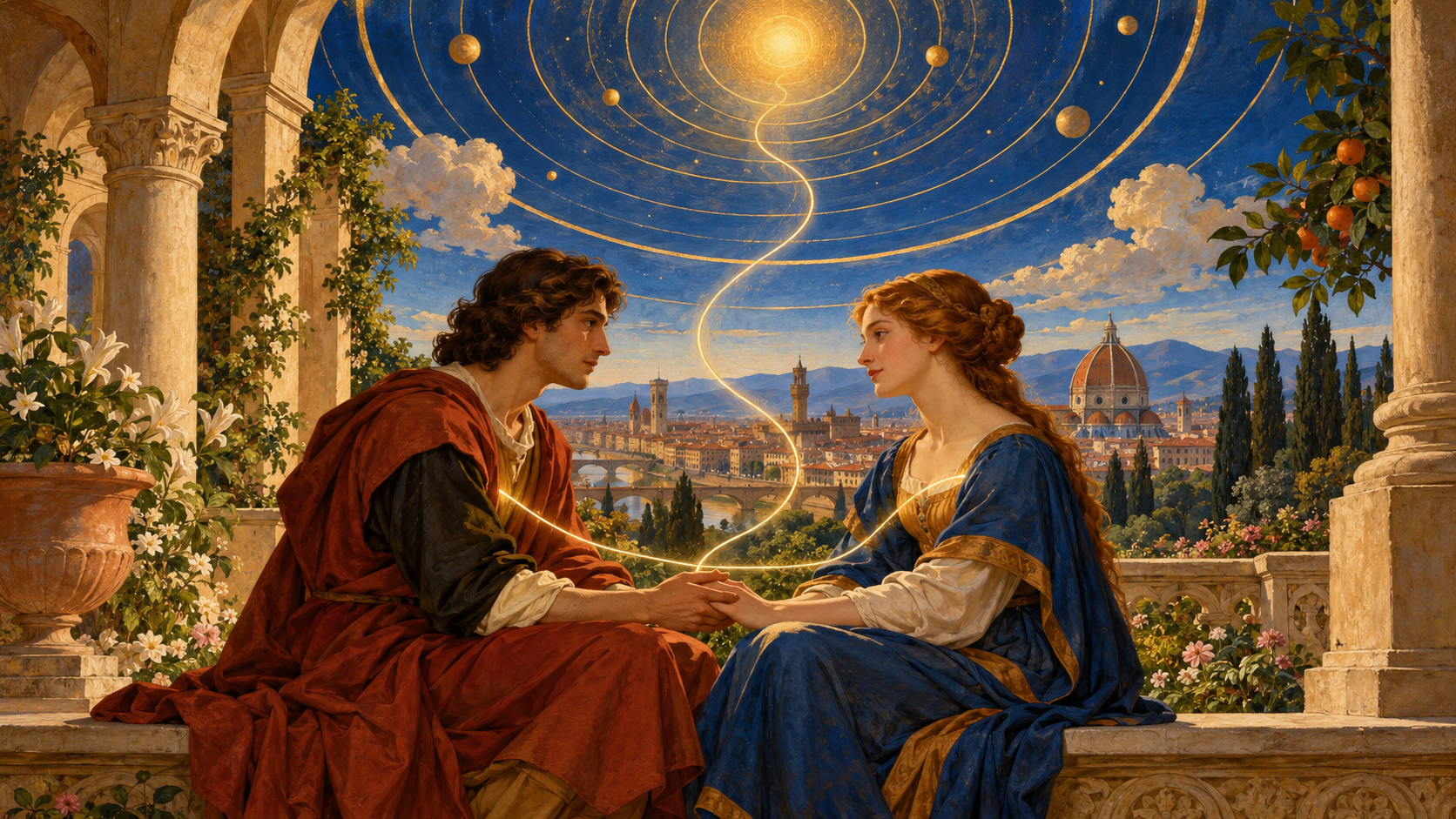
A landscape makes us stop for a moment. Another person’s presence moves us. A work of art seems to say more than its material can explain. Why does beauty affect us this way? For Marsilio Ficino, it can awaken in the soul a desire for a good that no single form exhausts. Love begins before something particular and opens a question about the origin of all beauty.
This intuition offers a fruitful entrance into the Theory of Descent. If Unity is the origin of all things, why do we live as distinct beings, able to desire, choose, draw near, and care for one another? The theory proposes that difference allows love to become experience. An encounter does more than recall the Source: through it, a possibility may acquire gesture, duration, and consequence.
Beauty may remind us of Unity; lived love asks what we will do for someone because of that remembrance.
Ficino and the return of Platonism
Marsilio Ficino (1433–1499) was a philosopher, translator, and priest in Renaissance Florence. His Latin translation of Plato’s dialogues and his studies of Plotinus played a decisive role in the circulation of Platonism in that period. A circle of scholars gathered around him and is often called the Florentine Platonic Academy. We need not imagine a formal institution with statutes and offices to recognize the importance of that intellectual community.
Among his works is a commentary on Plato’s Symposium, known as De amore. Ficino revisits the ancient question of Eros through a Neoplatonic and Christian outlook. His concern is not limited to the feeling between two people. He wants to understand why the universe holds together and why the soul, though placed among finite things, desires a beauty that seems to exceed them.
Historical distance matters. Ficino did not formulate the Theory of Descent, nor did he use its language of divine potentials becoming actual through experience. His project aims, above all, to lead the soul back to God. What follows is a contemporary philosophical dialogue, attentive to both affinities and differences.
Love as the desire for beauty
In his reading of Plato, Ficino defines love as the desire for beauty. This does not reduce love to attraction to appearances. A beautiful form may awaken attention, but the soul finds no final rest at its surface. Desire may move from visible form to inward qualities, to intellect, and ultimately to the source of beauty.
In this vision, particular beauty is not worthless; it is an occasion for awakening. A problem arises when the beloved becomes an object to possess, as though one life could be reduced to another person’s satisfaction. Love matures when it no longer mistakes a concrete presence for property and recognizes a dignity in the other that exceeds its own wishes.
Beauty, then, is not proof of a metaphysical thesis. It is an experience that may invite interpretation. Contemplating it, we may realize that we seek more than a beautiful thing: we seek meaning, communion, and a fuller form of life. That passage is not automatic. It depends on attention, discernment, and how we treat what first awakened desire.
From the beauty of a body to the question of the Source
Inspired by the ascent presented in the Symposium, Ficino describes a movement that begins with beauty perceived through the senses and may rise toward contemplation of the divine. The image of a ladder is often read too quickly, as though each new rung made the previous one useless. But a deeper question remains: what did the soul perceive in someone that made it long to see beyond appearances?
One possible answer is that sensible form points toward a meaning it cannot wholly contain. Admiring a face may lead us to attend to a person; recognizing that person may draw our attention to the life they share with us; and that recognition may awaken the question of the common ground of all lives.
In Ficino, this movement privileges elevation from the sensible to the intelligible. He does not deny that beauty appears in the world, but often gives greater value to what the soul finds beyond the body. This hierarchy is crucial to his philosophy—and it marks an important limit to the dialogue with the Theory of Descent.
Where the Theory of Descent takes another path
The Theory of Descent can welcome love as a binding power and beauty as an occasion for recognition. But it adds something: physical life has value in realizing what would be present in Unity as potential. The body is not merely the first rung of an upward ladder. It is also where loving intention becomes an embrace, food offered, presence beside someone, or work shared.
Space allows people to occupy distinct positions and lets one cross the distance to another. Time allows care and trust to be built, tested, and renewed. Individuality gives each encounter its singular character: we do not love “humanity” in place of the concrete person who speaks to us and awaits an answer.
That is why “to love is to remember” needs a companion claim: to love is also to make real. Remembering an original Unity may inspire care, but it cannot replace the choice to care. A reconciliation proclaimed in thought does not, by itself, repair a wounded relationship. Love’s potential becomes experience only when it takes shape in history.
In descent, love does not lose its origin by taking bodily form. It gains the possibility of being lived between distinct perspectives.
The paradox: how can Unity live love?
The video script behind this article asks a daring question: if the One is undivided Unity, how could it experience love as a relationship? Distinguishing love as principle from love as experience between subjects helps us think through the paradox. The theory proposes that Unity contains the possibility of love, while multiplicity offers the conditions in which someone can love and be loved.
This does not demonstrate that the One lacks anything or that creation results from a divine deficiency. When applied to the Source, “desire” is symbolic language for a metaphysical hypothesis, not a description of human need projected onto God. Nor does it mean that love exists only after absolute separation. Consciousnesses become distinct in experience while remaining connected to the same ground.
Lived difference makes possible gestures that undifferentiated Unity does not present in the same way: listening to a voice that is not mine, responding freely, learning from a perspective I cannot control. Distance here is a condition of relationship, not a sentence of exile. The other retains their reality and their right not to be absorbed by my desire for union.
The other is more than a mirror
The claim that we all participate in the Source can enrich love, but it can also be misused. If I say that I love only the presence of Unity in another person, I risk overlooking their needs, boundaries, and choices. The Theory of Descent takes otherness seriously only when Unity does not cancel singularity.
To love someone includes recognizing a life that does not belong to me. It means asking what that person wants, admitting that I may be mistaken about them, and respecting their consent and freedom. There is romantic love, but also friendship, family care, solidarity, and commitment to people we may never meet. None of these forms needs to be reduced to one emotional experience.
Such concrete care lets us distinguish union from fusion. In a fruitful relationship, two people may share life more deeply precisely because neither demands that the other disappear. Conscious communion preserves room for each.
Beauty, forgetting, and recognition
The video presents love as a memory of the Source. As a spiritual image, this is powerful: something beautiful may interrupt our routine and suggest that life exceeds our sense of isolation. In the language of the Theory of Descent, forgetting belongs to an individual perspective that begins to treat its separation as absolute; recognition discovers a shared ground.
But this process need not follow a rigid sequence. Not every desire leads to generosity. Not every experience of beauty awakens a sense of Unity. And a person need not find beauty in a painful situation for their life to have meaning. Love is not a prize for enduring suffering.
Recognition matures when it changes how we act. We may perceive beauty in nature and begin to protect it; admire someone’s courage and learn to keep a promise; discover in another face a life as real as our own and abandon indifference. Through such movements, remembrance of Unity draws closer to realization.
Love does not justify suffering
The script suggests that pain, conflict, and separation may run through the experience of love. This needs precision. Human relationships can involve loss and disagreement, and we can respond to them with care. It does not follow that violence, abandonment, or humiliation were necessary to produce a “higher” love. No theory of Unity should ask anyone to remain in an unsafe relationship to fulfill a supposed spiritual lesson.
If love is the realization of a potential, its signs should appear in its consequences: protection, responsibility, the freedom to say no, a willingness to repair harm, and respect for another’s liberty. Remembering a common Source does not erase boundaries. It may make them even more necessary when someone’s dignity is at risk.
Descent, encounter, and return
Ficino offers an image of love rising from particular beauty to the divine principle. The Theory of Descent proposes a complementary movement: Unity manifests in distinct perspectives, and through them love can become a lived relationship. Return, then, need not mean discarding everything that happened among the many.
The cycle can be described without making it an automatic formula: Unity contains possibilities; differentiation creates persons and circumstances; encounter allows choices; enacted care transforms those involved; and recognition of a common ground may integrate what has been lived without erasing those who lived it.
Love holds a special place in this journey because it joins origin and destination. It points to a connection prior to boundaries we imagine to be absolute, while becoming fully intelligible only in concrete acts across those boundaries. To return to Unity is not to forget the beloved. It is to learn to recognize them more deeply.
What Ficino leaves us—and what descent adds
Ficino teaches us to take beauty seriously: it can draw the soul out of self-enclosure and open a contemplative path. His account of love is more than a passing emotion; it belongs to a vision of the cosmos as a reality bound to its origin. The Theory of Descent finds a valuable insight here, but declines to treat our passage through the world as a stage whose purpose is exhausted when the soul rises.
From the perspective of descent, the decisive question is not only “where does beauty lead me?” but also “what does this beauty call me to make real here?” A moment of admiration may matter because it makes a more attentive relationship possible. Love may reveal its depth when recognition of Unity becomes choice, care, and fidelity to the other’s singularity.
To love may be to remember where we came from. It may also be to bring into being, between us, something that had not yet been lived.
Historical note and further reading
Ficino’s ideas about love, beauty, and the soul’s ascent are presented here in dialogue with his commentary on Plato’s Symposium. The language of “descent,” “potentials,” and “actualization through experience” belongs to the Theory of Descent; it should not be attributed to Ficino as his literal formulation. “To love is to remember” freely summarizes an interpretation of the video script and is not quoted as a passage from his work.
For historical and philosophical context, see the entry on Marsilio Ficino in the Internet Encyclopedia of Philosophy and a digital edition of his commentary on the Symposium.